
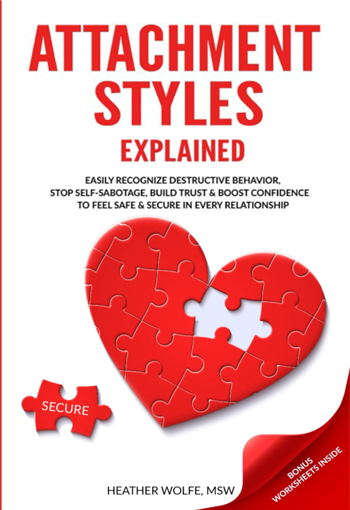
Attachment Styles Explained by Heather Wolfe: A Therapist's Review and Key Takeaways for Couples in 2026
Listen to this review on a podcast

As a relationship therapist, I've seen many clients struggle with recurring patterns that seem to undermine even the most loving partnerships, leaving one or both partners feeling anxious, dismissed, or perpetually on edge. These cycles of pursuit and withdrawal, reassurance-seeking, or emotional shutdown are often rooted in early experiences that shape how we connect as adults.
This book provides a clear, compassionate framework for recognising these attachment-driven behaviours and offers practical steps to interrupt self-sabotage and move toward more secure relating. In my sessions I frequently draw on similar concepts to help couples reframe their conflicts as understandable responses rather than personal failings, and I have found the insights here align closely with the work I do to foster empathy and lasting change.
Affiliate Disclosure: As an Amazon Associate, I earn from qualifying purchases. The links below are affiliate links, meaning if you click and make a purchase, I may receive a small commission at no extra cost to you. This helps keep my counselling session costs affordable for my clients.
Therapist's Quick Verdict: This is the best practical introduction to attachment styles and self-sabotage for real-world relationships. It is specifically designed for individuals and couples who notice repeating painful patterns but want straightforward, non-pathologising tools to understand why they happen and how to change them. It provides a clinical roadmap that links childhood wiring to adult behaviours, helping readers replace blame and reactivity with curiosity and secure responses.
| Author | Heather Wolfe |
| Publication Year | 2025 |
| Key Themes | Four attachment styles, self-sabotage patterns, inner-child healing, building secure bonds, practical exercises |
| Who is this book best for | In my clinical experience, this book is best for individuals and couples who feel trapped in repeating relationship conflicts. If you find yourself chasing reassurance, pulling away when things get close, or swinging between both, this guide maps directly onto those experiences. The self-assessments and step-by-step strategies fit busy lives and complement therapy perfectly. I rate it highly because it turns abstract theory into concrete actions that clients can use immediately between sessions. |
Key Features & Chapter Breakdown
Heather Wolfe begins with a gentle yet thorough introduction to attachment theory, explaining how our earliest caregiving experiences wire the nervous system for connection or protection. She avoids jargon while still honouring the science, making the material approachable for readers new to the topic or those already familiar with the basics. The inclusion of simple self-assessment tools right at the start allows readers to identify their dominant style and those of their partner before diving deeper, which I often recommend to clients as a shared starting point for conversation.
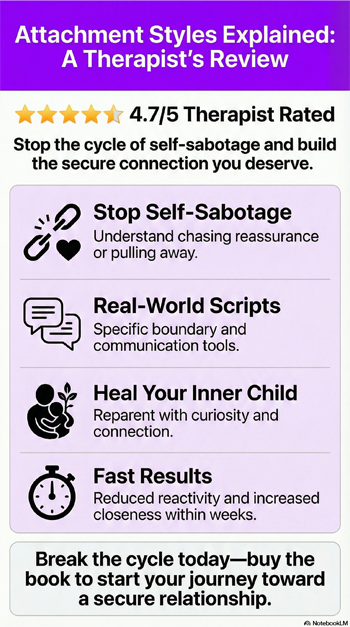
The middle sections dedicate focused chapters to each of the four styles – secure, anxious, avoidant, and disorganized – exploring how each manifests in adult relationships and the specific self-sabotaging behaviours that commonly arise. For example, the anxious style chapter details protest behaviours and reassurance-seeking, while the avoidant chapter examines emotional distancing and independence as defence. Real-life vignettes illustrate how these patterns play out in everyday scenarios such as arguments about time apart or difficulty expressing needs. Wolfe then provides targeted exercises for each style, including journaling prompts, boundary-setting scripts, and mindfulness practices that directly support the kind of emotional regulation work I guide couples through in session.
The concluding chapters shift to integration and growth, offering a clear pathway to earned security. Readers learn how to reparent their inner child, communicate vulnerabilities without blame, and co-create a secure base together. The final toolkit includes maintenance strategies for long-term relationships, making the book not just diagnostic but genuinely transformative. In my practice I have seen couples who work through these sections together experience reduced reactivity and increased closeness within weeks, validating the book's emphasis on small, consistent steps over dramatic overhauls.
Review & Analysis
This evidence-based guide stands out for its approachable explanation of attachment styles in relationships:
- Strengths: The book's greatest strength is its balanced, compassionate presentation that normalises insecure patterns without excusing harmful behaviour. Wolfe never suggests anyone is broken; instead she shows how every style carries both protective gifts and costs. This aligns closely with the acceptance-based approach I use in couples therapy. The integration of practical exercises with relatable examples makes complex ideas immediately usable, and the tone remains encouraging throughout.
- Weaknesses: Published recently, the book naturally builds on earlier works and some readers familiar with classics may find certain sections familiar. It is more focused on individual healing than on advanced couple dynamics, so those already deep in therapy may wish to pair it with joint exercises from other sources. A few examples feel generalised, though the core strategies remain solid and adaptable.
- Practical Applications: The exercises translate directly into daily life. An anxious partner can use the reassurance script to express needs calmly rather than escalating. An avoidant partner learns micro-moments of engagement that reduce their partner's anxiety without feeling trapped. Couples I work with often report that completing the style-identification quiz together removes blame and opens genuine dialogue.
- Current Relevance: Relevance remains high in 2026. With greater societal awareness of mental health and neurodiversity, readers appreciate a book that frames attachment variation as normal rather than pathological. The framework complements Emotionally Focused Therapy and schema work by adding a clear developmental lens, helping modern couples navigate digital communication, work stress, and blended families with greater understanding.
Pros and Cons
| Pros | Cons |
|---|---|
| Clear, compassionate explanations of all four attachment styles | Some overlap with more established attachment classics |
| Immediate, usable exercises for stopping self-sabotage | Primarily individual focus rather than extensive couple dialogue scripts |
| Strong emphasis on building earned security and inner-child healing | A few examples could benefit from greater cultural diversity |
Comparisons & Alternatives
If your primary struggle is anxious attachment and you want targeted techniques for reducing pursuit behaviours and building self-soothing, Defeat Anxious Attachment by Mindful Connections offers seven focused strategies that complement this broader book nicely. For those in a relationship with a dismissive-avoidant partner and seeking to understand emotional distancing without personalising it, Loving an Avoidant Partner by Krista Cantell provides deeper insight into the avoidant inner world and practical bridging techniques. Attachment Styles Explained sits comfortably as the most balanced starting point: more comprehensive on all styles and self-sabotage than the specialised titles, yet more immediately actionable than purely theoretical works.
| Book | Focus | Best For |
|---|---|---|
| Attachment Styles Explained by Heather Wolfe Check price ❯❯ | Broad overview of all four styles and self-sabotage patterns | Individuals or couples wanting a complete foundation and practical healing tools |
| Defeat Anxious Attachment by Mindful Connections Check price ❯❯ | Specific techniques for anxious attachment and boundaries | Readers with primarily anxious patterns seeking targeted self-awareness tools |
| Loving an Avoidant Partner by Krista Cantell Check price ❯❯ | Understanding and bridging emotional distance with avoidant partners | Partners of avoidant individuals wanting to reduce pursuit and build safety |
Therapist's Buying Guide
When selecting attachment-style books to support relationship work, look first for a strong, respectful presentation of the four styles that avoids labelling anyone as defective. Prioritise titles that include self-assessments and concrete exercises couples can complete together. The most useful resources discuss how styles interact in real relationships rather than focusing solely on individual diagnosis. Readability matters: the best books explain theory without jargon while still honouring the evidence. Finally, choose books that emphasise earned security and small, sustainable steps, as this approach aligns with the long-term, compassionate work that produces lasting change in couples therapy.
FAQs
Is this book suitable for people not currently in a romantic relationship?
Yes. The material on self-awareness and inner-child healing is valuable for anyone wanting to improve friendships, family dynamics, or prepare for future partnerships.
Can attachment styles actually change?
Absolutely. The book explains earned security through consistent small practices, and I regularly see clients achieve meaningful shifts when they apply these principles.
Does the book include exercises I can do with my partner?
Yes. Many of the communication scripts and joint reflection prompts are designed for couples to use together safely.
Is it too basic if I have already read "Attached"?
Not at all. This book adds a stronger emphasis on self-sabotage patterns and practical inner-child work that many readers find complements the classic nicely.
Will it help with high-conflict or anxious-avoidant traps?
Yes. The chapters on style interactions and de-escalation strategies directly address these common painful cycles.
How long does it take to read and apply?
Most readers finish the book in one to two weeks reading a chapter per evening, and many begin noticing relational improvements within the first month of consistent practice.
Conclusion
From a therapeutic perspective this book provides a robust clinical roadmap for understanding the biological and developmental underpinnings of relational patterns. The four-style framework aligns closely with cognitive-behavioural and attachment-informed work by offering a non-pathologising language for differences in emotional regulation, protest behaviours, and deactivation strategies. Couples who grasp these dimensions often experience rapid shifts from blame to curiosity, creating the safety needed for deeper emotional repair in sessions.
This book is especially well suited for individuals and couples who have accumulated years of unspoken assumptions about each other's behaviour. It directly addresses the pain point of feeling repeatedly misunderstood or trapped in the same arguments. The concise chapters and practical exercises fit the lifestyle of busy professionals and parents who need insight without lengthy workbooks or abstract theory alone.
The core outcome is greater compassion and more effective communication. If recurring misunderstandings or emotional distance have left you feeling disconnected from your partner, this book offers a scientifically sound path toward acceptance and collaboration. I recommend it to clients as a foundational resource that continues to inform their progress long after the final page.
Affiliate Disclosure: As an Amazon Associate, I earn from qualifying purchases. The links above are affiliate links, meaning if you click and make a purchase, I may receive a small commission at no extra cost to you. This helps keep my counselling session costs affordable for my clients. View the full Amazon Affiliate Disclosure.
About the Book Reviewer
Rhys Lewis MSc PgDip, is the founder of The Relationship Clinic Wales and a professionally qualified couples therapist.
He is the author of 300 Ways To Improve Your Relationship and Infidelity: A Survival Guide.
Rhys provides these reviews to help clients and readers find the most effective, evidence-based tools for relationship health. View his list of best relationship advice books for couples in 2026 here.
Connect with Rhys: