
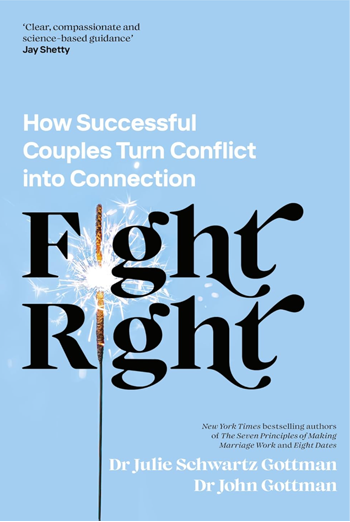
’Fight Right: How Successful Couples Turn Conflict into Connection’ by Julie and John Gottman: A Therapist's Review and Key Takeaways for Couples in 2026
Listen to this review on a podcast

As a relationship therapist working in the UK, I've helped many couples resolve those recurring arguments that erode trust and intimacy over time, often leaving couples feeling more like adversaries than partners. This book offers evidence-based strategies to reframe conflict as a pathway to deeper connection, emphasizing emotional regulation and mutual understanding. In my practice, I've used Gottman-inspired techniques to help clients navigate high-conflict situations, resulting in stronger relational dynamics and renewed empathy.
Affiliate Disclosure: As an Amazon Associate, I earn from qualifying purchases. The links below are affiliate links, meaning if you click and make a purchase, I may receive a small commission at no extra cost to you. This helps keep my counselling session costs affordable for my clients.
Therapist's Quick Verdict: This is the best book for high-conflict relationships. It provides a clinical roadmap for emotional regulation and relational dynamics, solving the problem of destructive arguments using research-informed techniques.
| Author | Julie Schwartz Gottman and John Gottman |
| Publication Year | 2024 |
| Key Themes | Communication, conflict resolution, building emotional bonds |
| Who is this book best for | In my clinical experience, this book is best for couples in high-conflict relationships who feel unheard by their partner. If you are looking for evidence-based quizzes to identify your conflict style and a step-by-step clinical roadmap to turn fights into deeper connections, this is my top recommendation. |
Key Features & Chapter Breakdown
Part 1: Conflict 101 explores why we fight, introducing the concepts of solvable and perpetual problems, and how conflict can lead to growth when handled properly.
Chapter 1: Why We Fight delves into the inevitability of conflict and its role in healthy relationships, with insights on physiological responses during arguments.
Chapter 2: Why We Fight the Way We Fight examines conflict styles - avoiding, validating, and volatile - and how to manage differences in approaches.
Chapter 3: What We Fight About categorizes common conflict triggers and underlying dreams or beliefs.
Part 2: The 5 Fights Everybody Has breaks down specific fight types like The Bomb Drop (harsh startups), The Flood (emotional escalation), The Shallows (surface-level arguments), The Standoff (stonewalling), and The Chasm (deep betrayals), offering strategies for each.
Part 3: Recovery focuses on repair attempts, processing regrets, and turning conflicts into opportunities for intimacy.
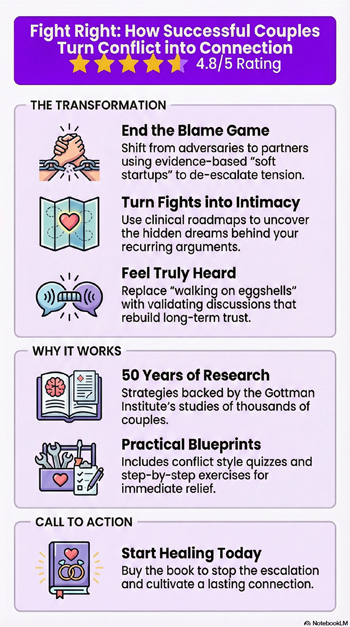
In my practice, I've used these concepts to help clients shift from blame to understanding, often incorporating soft startups to de-escalate tensions effectively.
Review & Analysis
This book stands out for its research-backed approach, drawing from over 50 years of studies on thousands of couples, providing a solid foundation for understanding relational dynamics.
- Strengths: Evidence-based research from the Gottman Institute, real couple examples that illustrate concepts vividly, practical exercises like soft startups and repair attempts that yield immediate results, emphasis on emotional regulation which aligns with cognitive-behavioral techniques.
- Weaknesses: Some readers familiar with previous Gottman works may find repetition in core concepts; less emphasis on diverse cultural contexts which could limit applicability for non-Western couples; assumes both partners are willing to engage, which isn't always the case in therapy.
- Practical Applications: The 'love maps' and conflict style quizzes have helped my clients deepen intimacy by uncovering hidden dreams behind arguments. In sessions, I've seen couples use the 5:1 positive-to-negative ratio to rebuild trust after betrayals; the de-escalation techniques are particularly useful for high-conflict pairs, turning volatile fights into validating discussions.
Pros and Cons
| Pros | Cons |
|---|---|
| Backed by 40+ years of research | Some examples feel dated without updates |
| Actionable exercises for immediate use | Quite technical in parts |
| Affordable and accessible for most readers | Not ideal for severe issues like abuse |
Comparisons & Alternatives
If you're looking for research-informed techniques, go with the Gottmans; for emotion-focused healing, choose Johnson; for broader conflict freedom, opt for Goldman-Wetzler.
| Book | Focus | Best For |
|---|---|---|
| Fight Right: How Successful Couples Turn Conflict into Connection by Julie and John GottmanCheck price ❯❯ | Research-driven marriage repair | Long-term couples |
| From Conflict to Closeness: Boost Communication & Satisfaction in Your Relationship by Rhys LewisCheck price ❯❯ | Communication boost | Couples seeking satisfaction |
| Optimal Outcomes: Free Yourself from Conflict at Work, at Home, and in Life by Jennifer Goldman-WetzlerCheck price ❯❯ | Emotional attachment theory | Those healing from disconnection |
Therapist's Buying Guide
When selecting relationship conflict resolution books, prioritize those grounded in evidence-based research, such as studies from reputable institutes, to ensure reliable advice. Look for readability with clear, accessible language that avoids excessive jargon, making it suitable for non-experts. Inclusivity is key - choose books that address diverse cultural backgrounds and relationship types. Practical exercises, like quizzes or step-by-step guides, enhance applicability in daily life.
FAQs
Is this book suitable for singles?
While primarily for couples, the principles of conflict styles and emotional regulation can apply to any interpersonal relationship, including friendships or family dynamics.
How does it compare to therapy sessions?
It's a great supplement but not a replacement for professional help, especially in cases of deep-seated issues or trauma.
Is it only for married couples?
No, it's applicable to any committed relationship, whether married, dating, or long-term partnerships.
Does it address cultural differences?
It touches on general dynamics but could offer more on diverse cultural contexts; supplement with inclusive resources if needed.
Is it repetitive if I've read other Gottman books?
Some core concepts overlap, but the focus on conflict provides fresh insights and specific strategies.
Can it help with conflict avoidance?
Yes, it covers avoiding, validating, and volatile styles, offering tools to encourage healthy engagement.
Is it suitable for severe conflicts like infidelity?
It addresses betrayals but recommends professional therapy for severe cases; use as a starting point.
Conclusion
From a therapeutic perspective, this book excels in promoting emotional regulation and attachment security, much like the techniques in cognitive-behavioral therapy or emotionally focused therapy that I employ in sessions. It bridges the gap between conflict and connection by encouraging cognitive reframing of arguments as opportunities for growth, comparing favorably to real-world therapy where couples learn to repair ruptures effectively.
This particularly helps those navigating long-term partnerships, who experience pain points like feeling disconnected or walking on eggshells amid escalating fights. The format, with its short exercises and conflict blueprints, fits busy lifestyles, allowing for quick implementations that foster empathy and reduce defensiveness.
For those ready to transform destructive patterns, this book offers the tools to rebuild trust and intimacy. Start applying its strategies today to stop escalations and cultivate lasting connection.
Affiliate Disclosure: As an Amazon Associate, I earn from qualifying purchases. The links above are affiliate links, meaning if you click and make a purchase, I may receive a small commission at no extra cost to you. This helps keep my counselling session costs affordable for my clients. View the full Amazon Affiliate Disclosure.
About the Book Reviewer
Rhys Lewis MSc PgDip, is the founder of The Relationship Clinic Wales and a professionally qualified couples therapist.
He is the author of 300 Ways To Improve Your Relationship and Infidelity: A Survival Guide.
Rhys provides these reviews to help clients and readers find the most effective, evidence-based tools for relationship health. View his list of best relationship advice books for couples in 2026 here.
Connect with Rhys: