
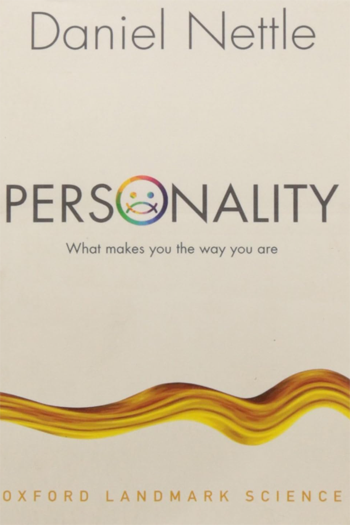
'Personality: What Makes You the Way You Are' by Daniel Nettle: A Therapist's Review and Key Takeaways for Couples in 2026
Listen to this review on a podcast

When working with clients as a couples therapist, I've seen many conflicts arise not from a lack of love or effort, but from fundamental differences in how each person is wired - differences in emotional stability, need for social stimulation, or their approach to routines and novelty.
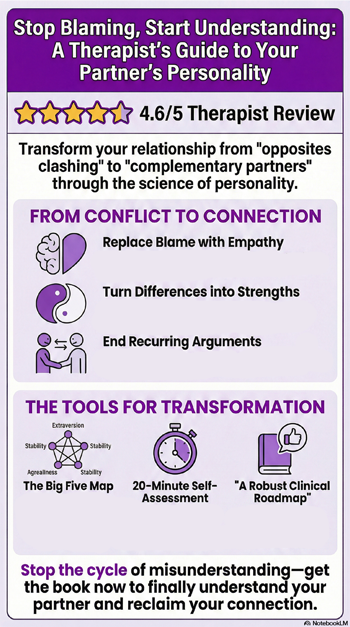
This book offers a clear, evidence-based map of the Big Five personality traits that shape these patterns, helping couples replace blame with an understanding of their partner. In my sessions, I've drawn directly from these insights to guide my clients toward greater empathy, more effective communication, and lasting relational repair.
Affiliate Disclosure: As an Amazon Associate, I earn from qualifying purchases. The links below are affiliate links, meaning if you click and make a purchase, I may receive a small commission at no extra cost to you. This helps keep my counselling session costs affordable for my clients.
Therapist's Quick Verdict: This is the best evidence-based book for understanding personality differences in long-term relationships. It is specifically designed for partners who want to move beyond surface-level conflicts to understand the biological and evolutionary roots of their differences.
| Author | Daniel Nettle |
| Publication Year | 2007 |
| Key Themes | Big Five personality traits, evolutionary psychology, biological basis of behaviour, self-understanding in relationships |
| Who is this book best for | In my clinical experience, this book is best for couples who feel repeatedly misunderstood or frustrated by their partner's behaviour. If you are looking for a research-driven guide with a self-assessment questionnaire that explains why one partner needs quiet evenings while the other craves social contact, or why anxiety and calmness coexist in the same relationship, this is my top recommendation. The book maps directly onto common relationship pain points such as emotional reactivity, differing needs for novelty, and habitual conflict patterns. |
Key Features & Chapter Breakdown
Daniel Nettle structures the book around the well-established Big Five personality dimensions: Extraversion, Emotional Stability, Conscientiousness, Agreeableness and Openness. Each trait receives its own dedicated chapter, introduced through memorable nicknames such as 'Wanderers' for high extraversion and 'Worriers' for low emotional stability. This makes complex scientific concepts immediately accessible and memorable for non-specialist readers.
The opening chapters establish the scientific foundation, explaining how personality traits are stable, partly heritable, and rooted in brain structure and evolutionary pressures. Nettle draws on genetics, neuroscience and longitudinal studies to show why these dimensions matter in daily life.
Subsequent chapters explore the advantages and disadvantages of high and low scores on each trait, illustrated with real-life case studies. The book concludes with the Newcastle Personality Assessor, a straightforward questionnaire that allows readers to score themselves and their partner on the five dimensions.
In my practice I've found the chapter on Emotional Stability particularly valuable. Many of my clients describe feeling like the 'worrier' in the relationship, carrying emotional responsibility while their partner appears more relaxed. Nettle's explanation that moderate Emotional Stability can drive vigilance and planning helps reframe this difference from a flaw to a complementary strength.
The Agreeableness chapter has helped numerous couples where one partner is highly empathetic and conflict-avoidant while the other is more direct and competitive. Understanding these as biologically influenced styles rather than moral failings reduces defensiveness and opens the door to collaborative problem-solving.
Review & Analysis
Strengths
The book's greatest strength is its balanced, evidence-based presentation. Nettle never suggests there is an 'ideal' personality; instead he shows that every position on each dimension carries both benefits and costs. This aligns closely with the acceptance-based approach I use in couples therapy. The integration of evolutionary psychology, genetics and neuroscience is rigorous yet explained in clear, engaging prose supported by vivid case studies.
The included self-assessment questionnaire is a practical highlight. Couples can complete it together in under twenty minutes and immediately see how their scores differ, providing a concrete starting point for discussion rather than vague complaints.
Weaknesses
Published in 2007, some of the cited studies have been superseded by more recent research on personality change and interventions. The book is also more focused on individual personality than on dyadic interaction, so readers seeking step-by-step couple exercises may need to supplement it. A small number of examples feel slightly dated in cultural reference, though the core science remains solid.
Practical Applications
The book's trait descriptions translate directly into everyday scenarios. A high-extraversion partner who feels restless at home can be understood not as rejecting family time but as needing social stimulation to recharge. A high-conscientiousness partner who plans every detail can be seen as providing valuable structure rather than being controlling.
The evolutionary perspective is especially helpful for long-term couples who have grown apart. Understanding that personality traits evolved because variation is advantageous for group survival helps partners view their differences as complementary rather than oppositional.
Relevance to modern relationships remains high in 2026. With increased awareness of neurodiversity and mental health, clients appreciate a book that normalises variation without pathologising it. The framework also complements evidence-based approaches such as Emotionally Focused Therapy and Schema Therapy by providing a biological lens on attachment and relational patterns.
Pros and Cons
| Pros | Cons |
|---|---|
| Strong scientific foundation from genetics, neuroscience and evolutionary psychology | Published in 2007; some newer research is not included |
| Clear, engaging writing with memorable real-life examples | More focused on individual traits than on couple-specific exercises |
| Includes a practical self-assessment questionnaire | Some sections contain technical scientific detail that may feel dense on first reading |
| Balanced view showing advantages and disadvantages of every trait | Not a substitute for professional therapy in cases of severe distress or abuse |
Comparisons & Alternatives
If you prefer a more personal, project-based approach to personality and well-being, Me, Myself, and Us by Brian R. Little offers practical strategies for aligning daily activities with your traits. For a more comprehensive academic treatment of personality psychology, The Personality Puzzle by David C. Funder is an excellent deeper dive. Nettle's book sits comfortably between the two: more scientifically grounded than many self-help titles yet more accessible than textbooks.
| Book | Focus | Best For |
|---|---|---|
| Personality: What Makes You the Way You Are by Daniel Nettle Check price ❯❯ | Biological and evolutionary basis of the Big Five traits | Couples seeking scientific understanding of personality differences |
| Me, Myself, and Us by Brian R. Little Check price ❯❯ | Personal projects and well-being through personality | Individuals wanting to apply traits to personal growth and daily life |
| The Personality Puzzle by David C. Funder Check price ❯❯ | Comprehensive academic overview of personality psychology | Readers wanting a textbook-style depth of theory and research |
Therapist's Buying Guide
When selecting personality books to support relationship work, look first for a strong empirical foundation grounded in the Big Five model, which remains the most robust and replicated framework in personality psychology. Prioritise titles that include practical tools such as self-assessments that couples can complete together. The most useful books also discuss how traits interact in close relationships rather than focusing solely on the individual. Readability matters: the best resources explain complex science without jargon while still respecting the evidence. Finally, choose books that emphasise acceptance of natural variation rather than promising to 'fix' personality, as this approach aligns with effective long-term couples therapy.
FAQs
Is this book suitable for singles?
Yes. While the relational applications are clear, the core content helps any adult understand their own patterns and improve self-awareness before or outside of a partnership.
Can personality really change?
Nettle explains that traits are highly stable yet show modest plasticity across the lifespan. The book encourages working with your natural tendencies rather than trying to become a completely different person.
How does it compare to therapy sessions?
It is an excellent complement to therapy but not a replacement. Many clients use the questionnaire and chapter summaries to accelerate progress between sessions.
Is it too scientific for the average reader?
The writing is accessible and story-driven. Technical sections are clearly signposted and can be skimmed without losing the main message.
Does it address cultural or gender differences?
The Big Five have been replicated across cultures, and the book notes average gender differences on some traits while emphasising individual variation within genders.
Will it help with specific issues like infidelity or high conflict?
Indirectly yes. Understanding traits such as high extraversion (linked to sensation-seeking) or low emotional stability (linked to emotional reactivity) can illuminate risk factors and protective factors in relationships.
How long does it take to read?
Approximately 250 pages. Most clients finish it in one to two weeks when reading a chapter per evening.
Conclusion
From a therapeutic perspective this book provides a robust clinical roadmap for understanding the biological underpinnings of relational patterns. The Big Five framework aligns closely with cognitive-behavioural and attachment-informed work by offering a non-pathologising language for differences in emotional regulation, social motivation and cognitive style. Couples who grasp these dimensions often experience rapid shifts from blame to curiosity, creating the safety needed for deeper emotional work.
This book is especially well suited for couples who have accumulated years of unspoken assumptions about each other's behaviour. It directly addresses the pain point of feeling like 'opposites' who no longer understand one another. The concise chapters and self-assessment tool fit the lifestyle of busy professionals and parents who need insight without lengthy workbooks or abstract theory.
The core outcome is greater compassion and more effective communication. If recurring misunderstandings or emotional distance have left you feeling disconnected from your partner, this book offers a scientifically sound path toward acceptance and collaboration. I recommend it to clients as a foundational resource that continues to inform their progress long after the final page.
Affiliate Disclosure: As an Amazon Associate, I earn from qualifying purchases. The links above are affiliate links, meaning if you click and make a purchase, I may receive a small commission at no extra cost to you. This helps keep my counselling session costs affordable for my clients. View the full Amazon Affiliate Disclosure.
About the Book Reviewer
Rhys Lewis MSc PgDip, is the founder of The Relationship Clinic Wales and a professionally qualified couples therapist.
He is the author of 300 Ways To Improve Your Relationship and Infidelity: A Survival Guide.
Rhys provides these reviews to help clients and readers find the most effective, evidence-based tools for relationship health. View his list of best relationship advice books for couples in 2026 here.
Connect with Rhys: