
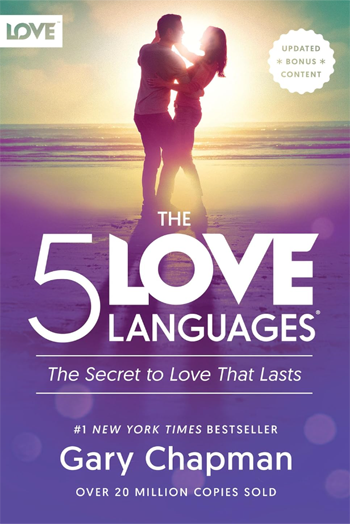
‘The 5 Love Languages: The Secret to Love that Lasts’ by Gary Chapman: A Therapist's Review and Key Takeaways for Couples in 2026
Listen to this review on a podcast

I frequently work with couples - many married for decades - who sit in my relationship clinic describing a profound sense of emotional disconnection. They often say, 'I love my partner, but they don’t feel it,' or 'We do things for each other, yet the spark is gone.' This classic book offers a clear, accessible framework for understanding how partners express and receive love differently, a concept I’ve recommended in sessions for years with consistent positive outcomes.
Affiliate Disclosure: As an Amazon Associate, I earn from qualifying purchases. The links below are affiliate links, meaning if you click and make a purchase, I may receive a small commission at no extra cost to you. This helps keep my counselling session costs affordable for my clients.
Therapist's Quick Verdict: This is the best book for couples feeling emotionally distant despite genuine efforts to show love. It provides a straightforward clinical roadmap for aligning expressions of affection with a partner’s primary emotional needs, outperforming more complex alternatives by offering a memorable, actionable framework that translates directly into improved relational satisfaction.
| Author | Gary Chapman |
| Publication Year | 1992 (updated 2015 edition) |
| Key Themes | Love languages, emotional connection, marital communication, keeping love alive |
| Who is this book best for | In my clinical experience, this book is best for struggling couples, especially in midlife, who feel misunderstood or neglected despite outward stability. It is ideal for partners who express love, care or affection diligently yet sense it is not received. If you are looking for a simple, memorable system to identify emotional needs and restore intimacy without overwhelming theory, this is my top recommendation. |
Key Features & Chapter Breakdown
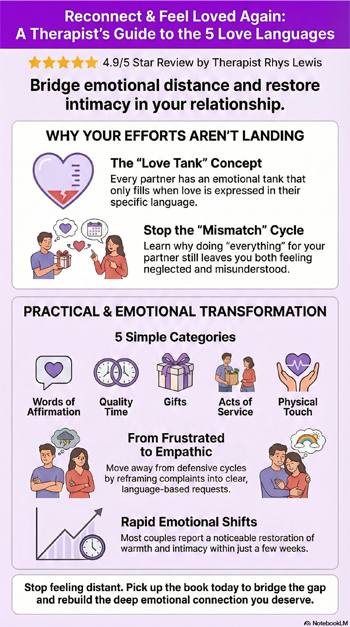
The book opens by addressing a common relational phenomenon: the fading of romantic love after the initial infatuation phase, introducing the metaphor of an emotional “love tank” that must be kept full for marital satisfaction.
Subsequent chapters systematically explore each of the five love languages - Words of Affirmation, Quality Time, Receiving Gifts, Acts of Service, and Physical Touch - using anonymised case studies from the author’s counselling practice to illustrate how mismatches create distance.
Later sections provide guidance on discovering one’s own and one’s partner’s primary love language, often through observation and a brief quiz, followed by practical suggestions for intentional expression. The closing chapters emphasise love as a choice rather than merely a feeling.
In my practice, I frequently use the love languages framework to help clients move from frustration to empathy, particularly when one partner feels chronically unappreciated despite the other’s efforts.
Review & Analysis
This enduring bestseller offers a deceptively simple yet profoundly useful lens for understanding relational dynamics.
- Strengths: The greatest strength lies in its accessibility and practicality. The five-category framework is easy to remember and apply immediately. Real-life couple examples resonate with clients I see, and the included quiz provides an objective starting point for discussion. From a therapeutic perspective, the emphasis on intentional love expression aligns with cognitive-behavioural principles of changing patterns through deliberate action. Many couples report rapid improvements in emotional connection after implementing even one insight.
- Weaknesses: The book is based primarily on clinical observation rather than large-scale empirical research, which limits its scientific rigour compared to works by researchers such as John Gottman. Some examples reflect traditional heterosexual marriage norms from earlier decades, and the Christian worldview woven throughout may not resonate with all readers. It also does not address severe relational issues such as abuse or infidelity in depth.
- Practical Applications: I regularly assign the love languages quiz as between-session homework. For busy middle-aged parents, focusing on small acts in the partner’s primary language - such as brief affirming notes or uninterrupted conversation time - often yields noticeable shifts in emotional tone within weeks. The concept helps couples reframe complaints (“You never say you love me”) into requests (“My love tank fills most when I hear encouraging words”). This approach supports emotional regulation and reduces defensive cycles I commonly observe in therapy.
- Relevance to Modern Relationships: Despite its age, the core insight remains highly relevant in 2026. Many couples today, stretched by work and family demands, express love in ways that go unnoticed because they do not match their partner’s primary language. The framework offers a non-blaming way to address this common source of disconnection.
Pros and Cons
| Pros | Cons |
|---|---|
| Simple, memorable framework that translates directly into daily behaviour | Lacks rigorous scientific validation compared to research-based alternatives |
| Includes helpful self-assessment quiz and real couple stories | Some examples and language feel dated |
| Highly readable and affordable | Contains Christian references that may not suit all readers |
| Practical for immediate application without overwhelming theory | Not designed for severe relational distress or abuse |
Comparisons & Alternatives
If you want the foundational concept with real-life stories, start with Chapman’s original. For structured exercises, choose the workbook. For broader communication and emotional intelligence skills, consider the Eden Storm title.
| Book | Focus | Best For |
|---|---|---|
| The 5 Love Languages Workbook by Gary Chapman Check price ❯❯ | Hands-on exercises and quizzes based on the original framework | Couples who prefer structured activities and homework-style learning |
| How to Read Your Partner's Mind by Eden Storm Check price ❯❯ | Communication, empathy, emotional intelligence, and nonverbal cues | Partners struggling to interpret emotions and thoughts accurately |
Therapist's Buying Guide
When selecting books about love language communication, prioritise readability and practical application over dense academic theory. Look for clear frameworks that clients can implement without professional guidance, yet still align with established therapeutic principles such as intentional behaviour change and empathy building. A moderate evidence base from clinical observation is valuable, especially when combined with traditional values around commitment and mutual service. Inclusivity matters, but timeless principles often transcend specific cultural moments.
FAQs
Does the book contain religious content?
Yes, the author is a Christian counsellor and includes biblical references, though the core framework is presented as universally applicable.
Is this book only for married couples?
The primary focus and examples are marital, but the love languages concept applies to any committed romantic relationship.
Can singles benefit from reading it?
Yes - many readers gain self-awareness and prepare for future relationships; there is also a separate “Singles Edition.”
Is the concept scientifically proven?
It is based on decades of counselling observation rather than controlled studies; recent research has questioned strict categorisation, yet the practical outcomes remain widely reported as positive.
Is it a substitute for couples therapy?
No - it is an excellent supplement and often recommended by therapists, but professional guidance is needed for deeper or entrenched issues.
How quickly can couples see results?
Many report noticeable improvement within weeks when both partners intentionally apply the principles.
Conclusion
From a therapeutic standpoint, The 5 Love Languages succeeds because it translates complex emotional needs into an accessible framework that encourages deliberate, empathetic action. The emphasis on choosing to express love in ways meaningful to the recipient mirrors techniques I use in cognitive-behavioural and emotionally focused work to shift entrenched patterns and rebuild secure attachment bonds. While not a comprehensive clinical manual, it consistently helps couples move from misunderstanding to mutual appreciation.
The book is particularly effective for couples who have drifted into functional coexistence despite the presence of genuine care and efforts to please one-another. Its straightforward structure and brief, targeted suggestions fit busy lifestyles, allowing even time-pressed parents to implement small but powerful changes that refill emotional reserves and restore warmth.
For couples ready to move beyond surface conflicts and rebuild deep emotional connection, this remains one of the most reliable and widely beneficial resources available. I encourage you to explore the concept together - it often marks the turning point toward a more fulfilling partnership.
Affiliate Disclosure: As an Amazon Associate, I earn from qualifying purchases. The links above are affiliate links, meaning if you click and make a purchase, I may receive a small commission at no extra cost to you. This helps keep my counselling session costs affordable for my clients. View the full Amazon Affiliate Disclosure.
About the Book Reviewer
Rhys Lewis MSc PgDip, is the founder of The Relationship Clinic Wales and a professionally qualified couples therapist.
He is the author of 300 Ways To Improve Your Relationship and Infidelity: A Survival Guide.
Rhys provides these reviews to help clients and readers find the most effective, evidence-based tools for relationship health. View his list of best relationship advice books for couples in 2026 here.
Connect with Rhys: