
Boundaries by Henry Cloud and John Townsend: A Therapist's Review and Key Takeaways for Couples in 2026
Listen to this review on a podcast

People often arrive able to describe their limit in a single sentence, then spend the next twenty minutes taking it back. They can be firm with a colleague, yet go quiet when a partner, a parent or a close friend asks for more than they can give. That gap, between knowing a limit and feeling allowed to keep it, is the problem Henry Cloud and John Townsend set out to address in Boundaries, subtitled When to Say Yes, How to Say No To Take Control of Your Life. This review is of the 2017 Updated and Expanded Edition of a book first published in 1992. It is a general-life guide to limits and personal responsibility, written with a biblical frame, not a couples-therapy manual and not a script workbook. My quick verdict: it remains one of the clearest accounts of why saying no feels so difficult, and of who is responsible for what in a close relationship.
The lasting value of the book is that model of responsibility. Cloud and Townsend, both clinical psychologists, argue that you are responsible for your own feelings and limits, and not for other people's reactions when you state them.
Affiliate Disclosure: As an Amazon Associate, I earn from qualifying purchases. The links below are affiliate links, meaning if you click and make a purchase, I may receive a small commission at no extra cost to you. This helps keep my counselling session costs affordable for my clients.
Therapist's Quick Verdict: This is a foundational, biblically framed guide to limits and personal responsibility, written by two clinical psychologists, for readers who need the underlying model of when to say yes and how to say no.
| Author | Henry Cloud and John Townsend (the jacket credits them as Dr. Henry Cloud and Dr. John Townsend) |
| Publication Year | 2017 (Zondervan paperback, Updated and Expanded Edition, 3 October 2017) |
| Key Themes | Limits and personal responsibility, guilt about saying no, biblical framing, marriage, family, friends, work, the self, and, according to the publisher, digital life |
| Who is this book best for | From a counselling perspective, this book is best for readers who want a clear model of who owns which feelings and limits, including in a marriage, and who are comfortable with an explicit Christian frame. It suits people who need the why of a boundary, not only a sentence to practise. |
Key Features & Chapter Breakdown
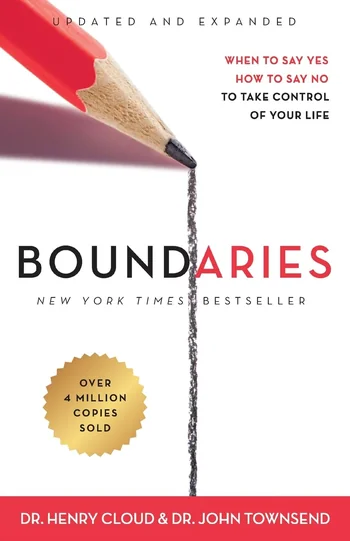
The edition reviewed here is the Zondervan paperback, Updated and Expanded Edition (ISBN-13 978-0310351801, 3 October 2017). The jacket credits the authors as Dr. Henry Cloud and Dr. John Townsend, and also prints "New York Times Bestseller" and a starburst claiming "Over 4 million copies sold". Those are jacket and official product-page claims, not figures I have independently verified.
According to the official product page, Cloud and Townsend "offer biblically-based answers" and show how to set healthy boundaries with a spouse, children, friends, parents, co-workers and yourself. The publisher says this update includes a new chapter on boundaries and the digital age, and addresses online dating, single parenting and the workplace. I am not setting out a chapter list, because none was confirmed from the book itself. The publisher's blurb also raises familiar questions about setting limits and still being a loving person, and about what to do if someone is upset by a boundary.
Review & Analysis
This long-running boundaries title stands out for its model of responsibility, and for an honest biblical frame:
- Strengths: The book's greatest strength is that model of responsibility: you own your own feelings and limits, and you do not have to manage the other person's disappointment when you keep them. That is clinically useful psychoeducation, and it applies in marriage as well as with family, friends and work. The Christian framing is explicit rather than hidden, which is honest, and will be a reason some readers choose the book.
- Author Credibility: According to Henry Cloud's own site (drcloud.com/about, read for this review), he is a clinical psychologist (B.S. in psychology, Southern Methodist University; Ph.D. in clinical psychology, Biola University; clinical internship at the Los Angeles County Department of Mental Health). That page also calls him a leadership expert and consultant and a New York Times bestselling author, and states that "His 45 books, including the iconic Boundaries, have sold nearly 20 million copies worldwide." According to John Townsend's own site (drtownsend.com, read for this review), he is a psychologist, leadership consultant and coach, and a New York Times bestselling author, and founder of the Townsend Institute for Leadership and Counseling (in partnership with Concordia University Irvine, per that site) and the Townsend Leadership Program. His site says he "has written over 30 books, selling 10 million copies, including the New York Times best-selling Boundaries series". Concordia University Irvine's Townsend Institute page lists a B.A. in Psychology from North Carolina State University, a Master's in Theology from Dallas Seminary, and a Ph.D. in Clinical Psychology from Biola University. Those book and sales counts differ across pages and should not be merged with the jacket claim of over 4 million copies sold for this title. The official product page also describes both as psychologists and New York Times bestselling authors.
- Weaknesses: This is not a script-led couples workbook, and readers who want sentences they can use today may find Nedra Glover Tawwab more immediately practical. The biblical framing will not suit every client. The book was first published in 1992, and even in the 2017 update the older core remains. I could not confirm a live Amazon customer-rating figure, because the product page was not readable when this review was prepared.
- Practical Applications: Use the responsibility model as a test in the moment: is this feeling mine to manage, or am I taking on someone else's? In a couple, that can mean stating a limit once, clearly, and not spending the evening undoing it. If a conversation about limits is marked by coercion or fear, seek professional help rather than relying on a book.
- Current Relevance: Relevance in 2026 remains high. People still struggle with guilt about saying no, and with the difference between a loving limit and an attempt to control someone else.
Pros and Cons
| Pros | Cons |
|---|---|
| A clear model of limits and personal responsibility, including in marriage | Biblical and Christian framing will not suit every reader |
| Written by two clinical psychologists, with a long publishing history | More about principles than ready-made scripts, so less wording to use at once than Tawwab |
| The 2017 update adds digital-age material, according to the publisher | First published in 1992, so the older core remains even in this update |
Comparisons & Alternatives
Choose Boundaries when you want the underlying model of responsibility, limits, and guilt about saying no, and you are comfortable with a biblical frame. Choose Set Boundaries, Find Peace by Nedra Glover Tawwab, my top pick on this theme, when you need a modern, therapist-authored guide with wording you can use today. Choose The Essentials of Setting Boundaries by Golden Hour Publications, my Client's Choice, for a shorter practical primer.
| Book | Focus | Best For |
|---|---|---|
| Boundaries by Henry Cloud and John Townsend Check price ❯❯ | A biblically framed, principle led guide to limits and responsibility | Readers who want the underlying model, including in a marriage |
| Set Boundaries, Find Peace by Nedra Glover Tawwab Read my review ❯❯ Check price ❯❯ | A therapist authored, script led guide to naming limits and reducing resentment | Couples who want practical wording they can use today |
| The Essentials of Setting Boundaries by Golden Hour Publications Read my review ❯❯ Check price ❯❯ | A short practical primer on setting limits and communication | Readers who want a brief introduction rather than a long classic |
Therapist's Buying Guide
When choosing a boundaries book, think about frame and format. If you want the underlying model of responsibility, and a Christian or biblical frame is welcome or at least acceptable, start here. If you need wording for the next difficult conversation, start with Set Boundaries, Find Peace. If you want a brief first read, start with The Essentials of Setting Boundaries. This title includes marriage, but it is a general-life guide, not a couples therapy programme.
FAQs
Is Boundaries a couples-therapy book?
No. It is a general-life guide to limits and responsibility, with a biblical frame. It discusses spouses, children, friends, parents, co-workers and the self, and is not a couples-therapy manual.
Is it a Christian book?
Yes. The official product page says Cloud and Townsend "offer biblically-based answers". The Christian framing is explicit, and this is not a secular clinical protocol.
Which edition is this review of?
The 2017 Updated and Expanded Zondervan paperback (ISBN-13 978-0310351801), not the 1992 first edition.
How does it compare with Set Boundaries, Find Peace?
Tawwab is my top pick when you need a therapist-authored, script-led guide and wording for the next conversation. Cloud and Townsend are stronger on the model of responsibility, with an explicit biblical frame.
How does it compare with The Essentials of Setting Boundaries?
Golden Hour is my Client's Choice and a shorter practical primer. Boundaries is the longer, principle-led classic, first published in 1992 and updated in 2017.
Conclusion
From a therapeutic perspective Boundaries supports two key tasks: making a clear distinction between what is yours to carry and what is not, and reducing the guilt that often arrives as soon as a loving limit is stated. It suits readers who want a foundational model of limits, including in a marriage, and who are comfortable with a biblical frame. It is a weaker first pick if you mainly need ready-made wording, or if a Christian frame would get in the way. The main outcome is a clearer sense of when to say yes, how to say no, and why that is not the same as being unloving.
Affiliate Disclosure: As an Amazon Associate, I earn from qualifying purchases. The links above are affiliate links, meaning if you click and make a purchase, I may receive a small commission at no extra cost to you. This helps keep my counselling session costs affordable for my clients. View the full Amazon Affiliate Disclosure.
About the Book Reviewer
Rhys Lewis MSc PgDip, is the founder of The Relationship Clinic Wales and a professionally qualified couples therapist.
He is the author of 300 Ways To Improve Your Relationship and Infidelity: A Survival Guide.
Rhys provides these reviews to help clients and readers find the most effective, evidence-based tools for relationship health. View his list of best relationship advice books for couples in 2026 here.
Connect with Rhys: